Strategy as a word is difficult to understand when reading many a blog post, as it’s not uncommon to find it mixed up with plan and planning. Add the fact that strategic planning is its own concept and confusion is real. People also misunderstand different levels of business, meaning strategy is theoretic roughly put, whereas plan takes it to practical. Defining these concepts with examples will take time, so bear with us and please check in regularly to see our progress of posting new content. Let’s jump into this quick overview of business strategy!

Defining Business Strategy And Strategic Planning
So how do you define a business strategy? And how do you develop one? First of all, strategy and plan can’t be used interchangeably, because they mean different things.
Strategic Planning comprises lots of things and the first three we’ve already covered in our blog post 3 Tips To Get Started With Business Strategy, namely vision, mission and values.
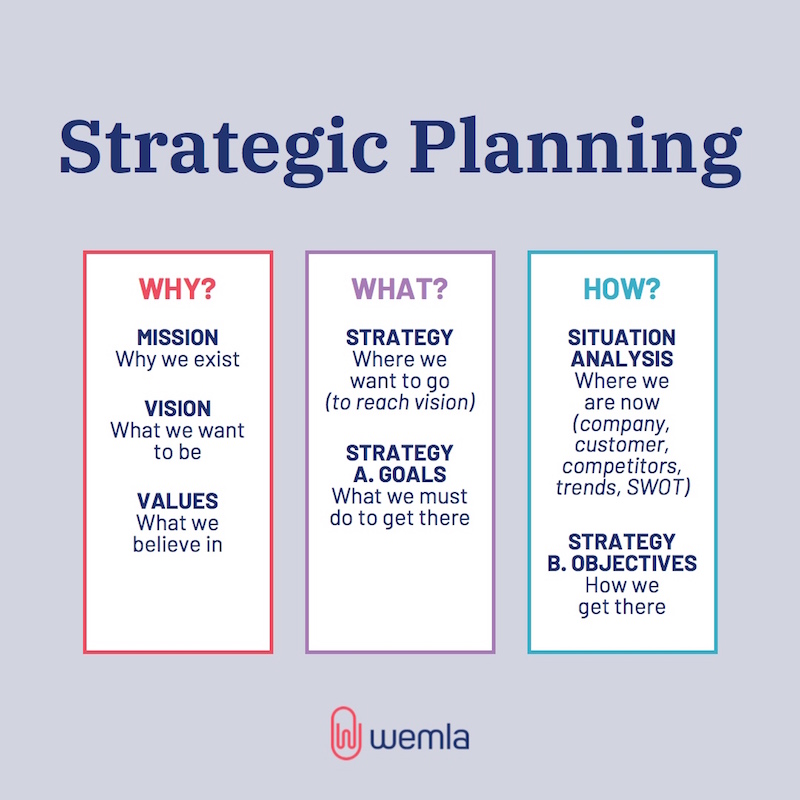
But before the vocabulary becomes too much, please have a look at our infographic below!
Why?
To the left of our infographic, we have three elements of Why: mission, vision and values. They answer the question why a firm even exists on a fundamental level.
What?
Once you know why you want to be in business, it’s logical to ask how you will achieve the desired end state, your vision of what you want to be. What do you need to do on airplane level do to move from point A to point B? Business strategy is the practice of how to get from today to the envisioned ideal state many years from now.
Goal is another word that get mixed up because people on the productivity scene come to it from different backgrounds. In business, goal setting is strategic and therefore on highest level.
As per strategy consultant Vaughan Evans words in “25 Need-to-Know Strategy Tools”: “Goal setting is the cornerstone of business strategy. Goals should underpin each of your company’s main strategic initiatives over the next five years or so.”
Another lightbulb moment, quoting Evans: “Goals are directional, objectives are specific.” A goal therefore isn’t a task, but what your business aims to be. In business vocabulary, you don’t have monthly, weekly and daily goals, but those can be tasks or action steps to offer two alternatives. David Allen calls them next actions in his method Getting Things Done.
How?
Before moving on to the objectives, however, it’s good to start the practical How with a situation analysis. It probably sounds fancier than it is. Take stock of what’s happening within the company and outside of it. Cover customers and competitors, suppliers and collaboration partners, trends in society both locally and globally, and the ever so useful SWOT (strengths, weaknesses, opportunities, threats) analysis.
The final part of strategic planning as per our infographic, building upon the situation analysis, would be objectives. Since these are specific like Evans said, we could rephrase that and state objectives are short-term and SMART (for specific, measurable, achievable, relevant, timely). They are targets and should be made measurable through for example numbers, so you know whether you achieved them or not.
There’s very little point in shooting in the dark and having no idea whether you hit or miss the goal. If it doesn’t matter how successful financially your efforts end up to be, you’re probably doing a hobby, as numbers are everything in business. It’s worth it to run a tight ship when profitability is at stake.
And Business Model?
How does business model fit in? If strategy is like a map to use for navigation, the business model is a snapshot in time of how the business currently is working to put strategy into practice.
Conclusion
The aim of this post is to be an overview so as with the 3 Tips blog post, we will update this with the latest available links to other posts covering one or more of these concepts. It’s easier for us to produce content that is linked to make sense and easier for you to bookmark just one rather than a large number of posts.
How does this seem? Complicated or just complex? We think it’s challenging to write precise sentences because stuff evolves into statements easily, yet there should be room for verbal adjustments and some debate, too. Post your thoughts in the comments below!
P.S. Please download the infographic if you want to save it for reference and share this post in social media as well. We published a first version of it on Instagram on 3 December 2019.
Our Content Covered In This Overview
- Why?
- 3 Tips To Get Started With Business Strategy: vision, mission and values
- What?
- Business Strategy
- Business Strategy: Goals
- How?
- Strategic Tools: The SWOT Analysis
- Strategic Planning: Objectives
- Other posts:
- Business Models
This blog post is the first in our beginner-level series A Business Strategy Primer.
Photo credit: Amy Hirschi.


Leave a Reply
You must be logged in to post a comment.